
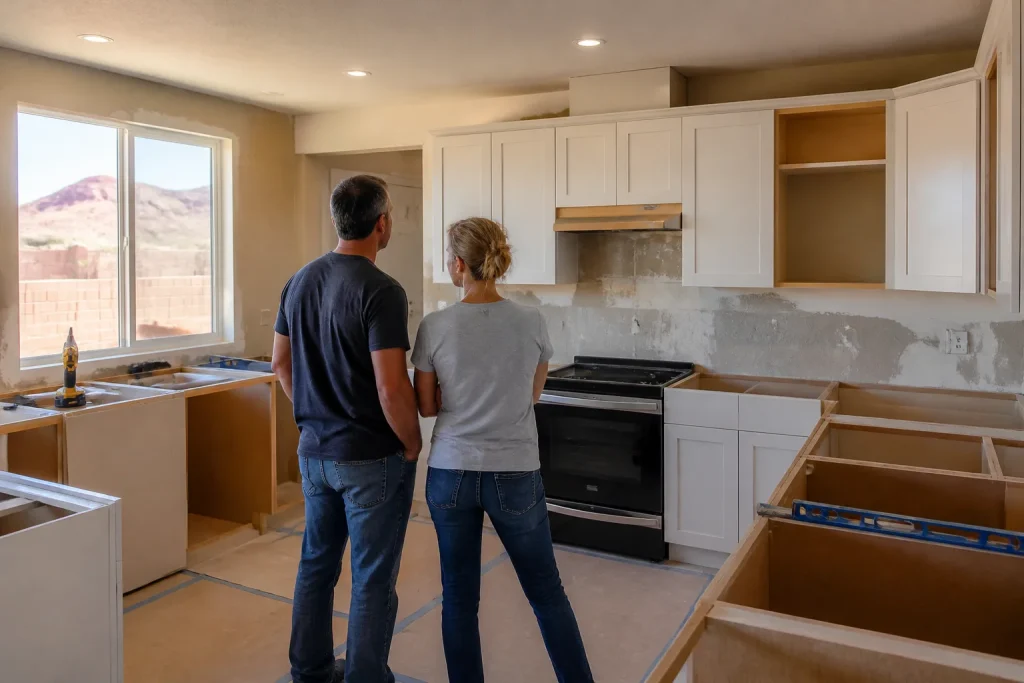

Home Remodeling: Repair or Replace? How Enterprise Homeowners Decide
Repair or replace comes down to three numbers: how much useful life is left in the existing system, what each path costs per year of use, and how much hidden damage the demo is likely to reveal. In Enterprise, the decision usually tilts toward repair when the structure and layout are sound and toward replacement when UV, soil movement, or water chemistry has already pushed a system past its realistic service life. If you’d rather not sort that out alone, call (844) 797-6157 and we’ll walk through it with you.
A contractor who recommends full replacement on the first visit hasn’t necessarily diagnosed your home – they’ve diagnosed their schedule. We’ve watched homeowners in Enterprise get quoted a full kitchen tear-out for what turned out to be a failed shutoff valve and a warped cabinet box. We’ve also watched a homeowner patch a bathroom floor for the third time when the subfloor underneath had no business holding tile anymore. The right answer depends on evidence, not on what the contractor has room for this month.
Key Takeaways
- Compare repair and replacement by cost per year of remaining use, not by sticker price alone.
- In Enterprise, extreme UV, soil settlement, and hard water age systems faster than national averages suggest.
- Any written price should spell out what happens if demo reveals hidden damage – before work starts.
- Ask a contractor what evidence supports their recommendation. A specific answer is a good sign; a vague one isn’t.
What age and condition thresholds actually matter per system?

Every material has a realistic service life, and in Enterprise that life gets compressed by sun, heat, and soil. These are the thresholds where repair tends to stop paying for itself:
- Kitchen cabinets and countertops: Cabinet boxes in good structural shape can be refaced or repainted for a fraction of replacement cost. Once frames are soft, out of square, or water-damaged at the base, replacement is usually the cheaper long-term path. Laminate counters past 12 to 15 years typically aren’t worth resurfacing; quartz and natural stone hold up far longer and are worth repairing.
- Bathrooms: A failed shower pan or loose tile is a repair conversation until you find water tracking into the subfloor. Past roughly 20 years on original fixtures and waterproofing, replacement usually wins.
- Roofing: Asphalt shingles in Enterprise take heavy UV exposure. Once you’re past 15 to 18 years with granule loss and recurring leaks in different spots, patch repairs start stacking up faster than a replacement pays back. We install GAF and Owens Corning systems for exactly this reason – the material warranties are worth more here than in milder climates.
- HVAC and its interface with remodels: A system that’s 12 to 15 years old and already struggling doesn’t get better when you add a new kitchen. If a remodel changes the load on the house, size the equipment to the new space rather than reusing a tired unit.
None of this is a hard rule. It’s a starting filter, and the actual answer lives in your home’s condition. If you want it evaluated properly, our General Contractor in Enterprise team walks the space with you before recommending anything.
How do you calculate cost per year of use?
Here’s the math that turns a gut feeling into a decision. Take the cost of each option and divide it by the years you expect to get out of it. The lower number wins.
- Estimate remaining life for the repair. A $900 repair that buys you six more years costs $150 per year.
- Estimate the replacement cost and its full service life. A $14,000 replacement with a 20-year life costs $700 per year – but that’s not the whole comparison.
- Adjust for the repair’s risk. If the repair has a 50% chance of failing inside two years and forcing the replacement anyway, the effective repair cost is much higher than it looks.
- Add the disruption cost. A repair keeps the kitchen usable for a weekend. A full replacement means weeks of eating out and living around the work.
- Compare like with like. A repair that buys three years against a replacement that lasts 20 is not a fair fight on sticker price. It is a fair fight per year.
Run those numbers and the answer usually gets clear fast. In our experience in Enterprise, the repair wins when remaining life is five years or more and the failure is isolated. Replacement wins when repairs cluster, when the same system fails in different places, or when you’re already planning to sell within a few years and want the disclosure clean.
What is the open-wall discovery problem, and how should a written price handle it?
This is the part of remodeling that hurts homeowners most, and it’s entirely predictable. Demo reveals things nobody could see through drywall: rotted framing, a cracked drain line, aluminum wiring spliced to copper, a subfloor that flexes. The repair-or-replace calculus can flip mid-project, and how a contractor plans for that moment tells you more about them than any showroom tour.
A written price should include a defined process for discoveries, not just a number:
- What triggers a change order. The written price should state plainly that work pauses, you’re shown the issue, and nothing proceeds until you approve a revised number in writing.
- Who decides. You do. Not the crew lead, not a phone call from the office. Any contractor who can’t put that in writing is one you should question.
- A realistic allowance. A good quote for a 1980s Enterprise bathroom includes a stated allowance for subfloor and waterproofing surprises, so the final number doesn’t lurch.
- The thresholds in advance. “If we find more than X, here’s what replacement costs” – agreed before demo starts.
We’ve pulled tile off a bathroom floor in Enterprise where the repair quote was $2,000 and the final answer was a full rebuild once we saw the damage. That homeowner knew the trigger and approved it before we moved forward. That’s the conversation to have on day one.
What makes Enterprise conditions tip the decision toward replacement?
Climate changes the math. Three local factors push systems toward replacement faster than a generic service-life table will tell you:
- Extreme UV. Southern Nevada sun degrades roofing, exterior paint, and sealants faster than most of the country. A roof that would last 25 years in a milder climate may be showing real wear at 15 here.
- Soil settlement. Expansive soils and the settling that comes with them open cracks in slab tile, throw doors out of square, and stress plumbing under slabs. When settling is the root cause of a repair, patching the surface buys you a return visit.
- Water quality. Hard water shortens the life of fixtures, cartridges, and shower valves. A 20-year-old Kohler or Moen shower valve doesn’t owe you anything after that much scale buildup – replacing it during a bath remodel is usually smarter than rebuilding it.
We regularly see bath remodels in Enterprise where the tile itself was fine but the waterproofing behind it had given up years earlier. That’s a replacement, not a repair, and it’s why waterproofing details matter more than surface finishes. Our Bathroom Remodeling in Enterprise team builds that into the plan from the start.
How do you tell whether a recommendation is about your home or their schedule?

Most contractors are honest, and most recommendations are grounded in what they see. But you should still be able to tell the difference between a diagnosis and a sales pitch. Here’s what to look for.
- Ask to see the evidence. A specific answer (“your subfloor is soft here, the drain line is cracked here, this joist is sistered”) is a diagnosis. “It’s just time” is not.
- Ask what repair would buy you. A contractor who can’t tell you how many years a repair would buy is guessing. One who can is thinking about your cost per year, not their margin.
- Ask about their backlog – politely. A shop with a full schedule can still recommend a small repair, and a slow shop can still recommend a replacement. But if every recommendation you get is “full replacement” and the start date is whenever the truck is free, ask why.
- Watch what happens when you push back. A good contractor walks you through the reasoning and wants you to understand it. A weak one gets defensive or pushes harder.
- See what’s in stock. If the recommendation matches the material sitting in the shop rather than your home’s condition, that’s a tell.
The kitchen is where this shows up most. A contractor with a cabinet delivery arriving next week has a strong incentive to tell you the layout needs a full tear-out. A focused repair may solve the same problem for a fifth of the cost – and sometimes it won’t. Ask. Our Kitchen Remodeling in Enterprise team starts with the walk-through and the diagnosis, not the finish schedule.
When to call a pro
Some of these jobs are genuinely dangerous, and we want to say that plainly. Roofing work is height work: a ladder slip or a missed step is a real injury, and we recommend leaving roof inspections and repairs to trained, insured crews. Anything touching gas lines, electrical panel work, or removing structural walls is a stop-and-call. Even for surface repairs, if you’re not sure whether a wall is load-bearing, stop and bring in a professional.
For the rest, our technicians have up to 22 years of experience. Every crew member is identity-verified under The Threshold Standard – you’ll get their name and photo before the visit, and a photo ID badge at the door on arrival. Live person answers every call, every day. And every project comes with a written price before any work starts, so you know the number before the tools show up.
Related services in Enterprise: Mason Remodeling Enterprise home and General Contractor in Enterprise.
The Bottom Line
Repair or replace is a financial question with a condition check on top, not a contractor’s preference. Compare cost per year of remaining use. Treat open-wall discoveries as a planned event, not a surprise – written price, your approval, before work continues. And in Enterprise specifically, let the climate tip you: UV, soil movement, and hard water push systems past their service life sooner than generic tables suggest.
If you’re in Enterprise and aren’t sure which side of the line your project falls on, we offer free estimates. Call (844) 797-6157 and we’ll walk through it, put a written price in front of you, and back the work for 365 days from the completion date.
Frequently Asked Questions
Cabinet refacing and countertop replacement typically run in the mid four figures, while a full kitchen replacement in Enterprise generally lands well above that. The meaningful comparison is cost per year of remaining use – a repair that buys eight more years at a third of the replacement cost is usually the right call, unless the frames are failing. Call (844) 797-6157 for a written price on your specific kitchen.
Not without your written approval. A written price is standard on every project, and if demo reveals hidden damage that changes the scope, work pauses, you see the issue, and you approve a revised number in writing before anything continues. No surprise invoices. Call (844) 797-6157 to schedule your free estimate.
Yes. Permitted work is pulled properly and inspected, and that matters for your resale down the line. Ask any contractor before signing whether the scope requires a permit – if the answer is “we’ll handle it,” ask for the permit number once it’s issued. For a free estimate, call (844) 797-6157.
A targeted repair can be a day or two. A bath replacement is typically a couple of weeks; a kitchen lands in the four-to-six week range depending on cabinets, counters, and any layout change. You’ll get a realistic schedule in writing with the price, not a verbal guess. Call (844) 797-6157 to talk through yours.
Written by the team at Mason Remodeling Enterprise.
Need Construction Help?
Call Mason Remodeling Enterprise - licensed & insured, here with fast after-hours help in Enterprise.
(844) 797-6157